Updated 06 / 07 / 2026
Learn how to build a capsule wardrobe in India that works for ethnic and western wear. Wardrobe essentials, colour palette tips, and a complete breakdown.

Aeza Editorial
Core team
A capsule wardrobe isn't about owning less; they're about owning better. Less decision-making every morning. More outfits from fewer clothes. A wardrobe that actually functions.
The opposite holds in most cases for Indian women. The closet is stuffed with three-year-old kurtas, sarees bought for a specific event, slightly oversized jeans, and dresses that got only a single use. However, it all adds up to an empty wardrobe by dawn — there's still nothing to wear!
The solution lies in building a capsule wardrobe india system. Rather than acquiring clothing for a particular purpose or an impulse purchase, the idea is to make a deliberate selection that would ensure each item matches at least three other items.
This guide walks you through exactly how to build one, what to include, and how to make it work for the Indian context, ethnic wear included. If you haven't pinned down your direction yet, our aesthetic guide for Indian women and our take on finding your personal style in India are good companions to this one.
India has a unique wardrobe challenge that most global capsule wardrobe guides completely ignore.
You dress for two parallel universes. One is western, office formals, casual weekend outfits, and night-out looks. The other is ethnic, family functions, festivals, weddings, and puja at home. A capsule wardrobe women in India needs to account for both. A guide that only talks about white shirts and straight-leg jeans is only solving half the problem.
The Indian capsule wardrobe is hybrid by design.
The average Indian wardrobe is full of:
The solution does not come from more shopping but through a system.
Before buying anything, go through what you already own.
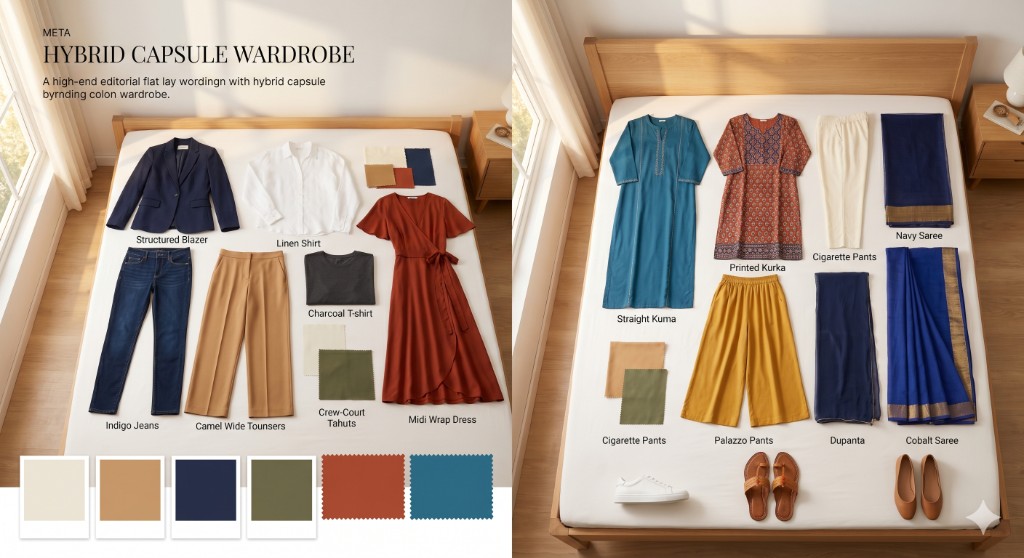
Pull everything out. Every kurta, every pair of jeans, every dupatta, every dress. Lay it on the bed. Now sort it into three piles:
Be honest with the Maybe pile. If you have to think about it for more than ten seconds, it belongs in the Out pile.
After the edit, what you want is a base of pieces that:
This edited wardrobe is your starting point. Now you build on it intentionally. If your body has been changing, our guide on rebuilding a wardrobe after weight loss covers how to edit without over-buying.
The success or failure of capsule wardrobes is determined by their colour harmony. Once all pieces go well with each other, the number of possible outfits increases without purchasing new clothes.
The formula: three neutrals + two accent colours.
Neutrals are the backbone. They go with everything.
For Indian skin tones, the most universally flattering neutral base colours are:
Pick two colours you are genuinely drawn to, and that complement your skin tone. These should appear in your ethnic and western pieces alike; that is what creates a unified wardrobe. Getting colour right against Indian skin is exactly what generic online shopping keeps getting wrong.
Strong accent choices for Indian wardrobes: rust, mustard, terracotta, teal, deep pink, cobalt, burgundy.
These are the wardrobe essentials that handle your daily western dressing needs, office, weekends, casual outings, and travel. If you're building toward a new job, pair this with our first day at a new job outfit guide.
That is 15 to 18 western pieces. Enough to build dozens of combinations.
That is where most capsule wardrobe guidelines end, but that is where this one doesn't.
Ethnic wear for Indians deserves to have a capsule system of its own. The aim remains the same.
For that one statement saree or lehenga, choosing for the occasion matters more than buying many — our wedding guest outfit guide by occasion helps you pick the one that earns its place.
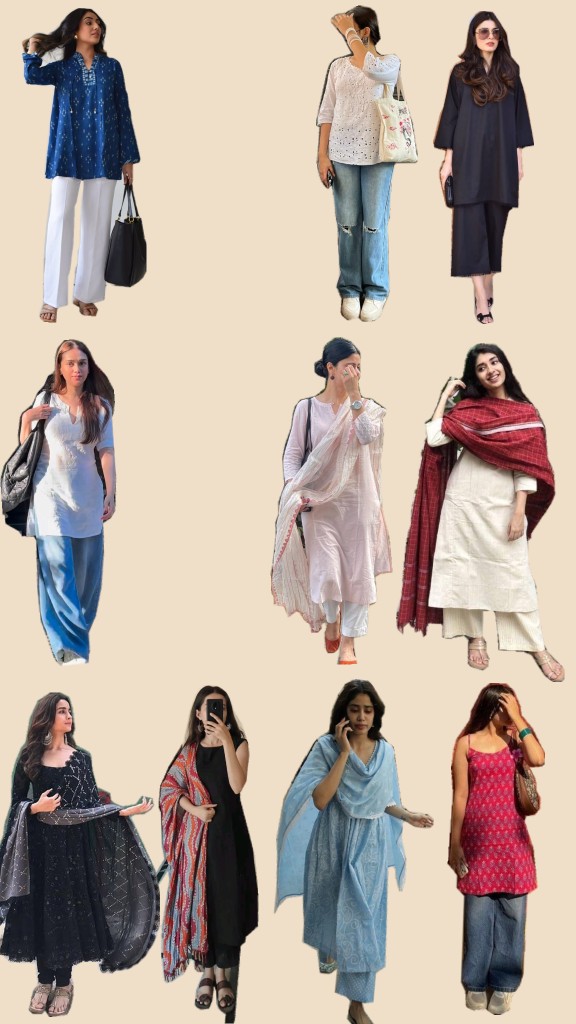
India has a natural capsule wardrobe advantage that western style systems don't: Indo-western dressing.
A short kurta paired with straight jeans and white shoes does not comprise a half-finished outfit; rather, it constitutes an entire outfit. A printed palazzo paired with a fitted T-shirt is appropriate attire for a Sunday brunch. Wearing a dupatta over a plain dress changes a western outfit to an eclectic one.
These cross-category pieces stretch your wardrobe further than any western capsule system accounts for.
After the edit and the ethnic-western audit, you will have a gap list. Pieces your wardrobe genuinely needs, not things you want, but things that would complete combinations you already have.
Shop the Gap list only. This is the discipline that separates a capsule wardrobe from a regular wardrobe.
When you do buy, shopping clothes online in India works far better with a few rules in place:
A capsule wardrobe is not a one-time project. It needs a light maintenance habit.
A wardrobe of 30 well-chosen pieces, in a cohesive colour palette, built across ethnic and western, that is the Indian capsule wardrobe.
Building a capsule wardrobe is the foremost step. Knowing how to style it every day is the second, and that is where most people get stuck again.
When your capsule has a gap, Aeza is India's discovery-led AI fashion marketplace makes filling it simple. Describe the piece you are missing, a structured kurta for Monday meetings or a neutral co-ord for weekends, and discover options from 30+ Indian brands. Try them on virtually and get your size right in every brand before you buy, part of the broader shift from ecommerce to AI commerce in Indian fashion.
Find the pieces your capsule needs on Aeza.
FAQ
The typical number of items in a capsule wardrobe is usually between 25 and 35 items. If we take the case of Indian women who dress in both traditional and western styles, then an ideal number would be somewhere around 30 to 33 items, considering that these include clothes and shoes as well. However, the important aspect here is the coordination of the items rather than their numbers.
Yes, and for Indian women, it should. A capsule wardrobe built only on western basics ignores half of the actual dressing needs. A well-built Indian capsule includes 3 to 4 kurtas, 3 ethnic bottoms, 2 to 3 dupattas, and one strong saree or lehenga. These pieces should share a colour palette with the western half of the wardrobe, so they cross over where possible.
It all starts with an edit and not a shopping spree. Get everything out and divide into three categories: Keep, Maybe, and Toss. Anything that ends up in the Keep category forms your basis. Just figure out which combination you don't have yet, and voila! That is your deliberate shopping list. You will be surprised how much you actually have.
No. A capsule wardrobe is a system for getting more wearability from fewer pieces. It is a practical tool, not a lifestyle statement. You can have a maximalist aesthetic within a capsule framework. The point is that every piece earns its place and works with others, not that you own as little as possible.
The highest-utility pieces for an Indian capsule are: one well-fitted blazer, two solid kurtas in neutral or accent colours, one pair of straight-leg jeans, one pair of wide-leg trousers, one wrap dress or midi dress, and one versatile saree or lehenga. These alone cover most occasions an Indian woman dresses for, office, casual, family functions, and weddings.
Yes, but with one exception: plan your capsule using items that offer some flexibility. Wrap dresses, waist-closure pants, A-line kurtas, and stretchable bottoms are just some examples of capsule-appropriate clothing items that adapt to the changes in your body rather than having to be replaced.
.webp)