Updated 05 / 11 / 2026

AI commerce starts with you & ecommerce with inventory. Here is what that difference means for Indian fashion, & why it matters for shoppers and D2C brands.

Aeza Editorial
Core team
Ecommerce took the store and put it online. AI commerce takes a stylist and puts her into the store. And just that one change makes all the difference, particularly when it comes to Indian fashion.
Online retailing has been a fairly universal experience over the past twenty years. Catalogs. Search. Shopping carts. You browse, you try your best, you purchase, and occasionally return the items. Your mission? Discover how to use the goods provided by the online platform.
That model worked well enough when the alternative was travelling to a physical store. But it was never actually good at fashion. Fashion is personal. It depends on your body, your skin tone, your occasion, your budget, and the thousand small preferences that make your style yours. A catalogue and a search bar cannot hold all of that.
With AI commerce, it is completely different from what you might be used to. Rather than having your purchase journey start with inventory, it starts with you and develops from there. The importance of knowing AI commerce vs ecommerce lies not in understanding technical differences, but in recognizing the importance of a system that was made for you, rather than against you.
Ecommerce, at its core, is the digitisation of retail. It moved the store online. It made inventory accessible from anywhere, at any time, at lower overhead costs than physical retail.
That is genuinely valuable. Indian ecommerce grew from near zero to a multi-billion-dollar industry in under fifteen years. It gave consumers in smaller cities access to products they could not find locally. It gave small Indian D2C brands a route to national distribution without a physical store network.
But ecommerce was designed around inventory management and transaction processing, not around the human being making the purchase decision.
What ecommerce does well:
What ecommerce was never designed to do:
The search bar is the clearest symbol of ecommerce's limitation. It returns results based on keywords, not based on who you are.
AI commerce is a framework where artificial intelligence is embedded into the core of the shopping experience, not added on top of it as a feature, but built into how products are discovered, recommended, and purchased — in practical terms, that looks like personalised outfit recommendations and virtual try-on instead of a search bar.
In ecommerce, the product is the starting point. In AI commerce, the person is.
Think of it this way: ecommerce is a very well-organised library. Everything is catalogued, searchable, and accessible. But you still have to know what you are looking for. AI commerce is a librarian who knows your reading history, your preferences, your current mood, and what you are trying to accomplish, and pulls exactly the right book before you have finished describing what you want.
1. Discovery logic
Discoveries in ecommerce are made by searches and browsing. When you enter the search string, the system gives you products matching the entered term. Discoveries in AI commerce are made by learning about the user. It creates an identity profile for you and provides things matching your identity even before you search for them.
2. Personalisation depth
Personalisation in ecommerce is mostly behavioural: "You viewed these items, and here are some other items related to your browsing." This is an attempt at making pattern matches on your behaviour. Personalisation in AI commerce, however, is structural, where it uses factors like your physique, complexion, preferences, occasion, and previous buying successes to create a personalised recommendation for you.
3. The role of the platform
For ecommerce, the platform is the market. For AI commerce, the platform is the stylist. The relation between the user and the platform changes completely, since it changes from being transactional to advisory.
Indian fashion is one of the most complex retail markets in the world. And that complexity is exactly why the ecommerce model has always fallen short here, and why AI in fashion ecommerce is not just an improvement but a genuine fix.
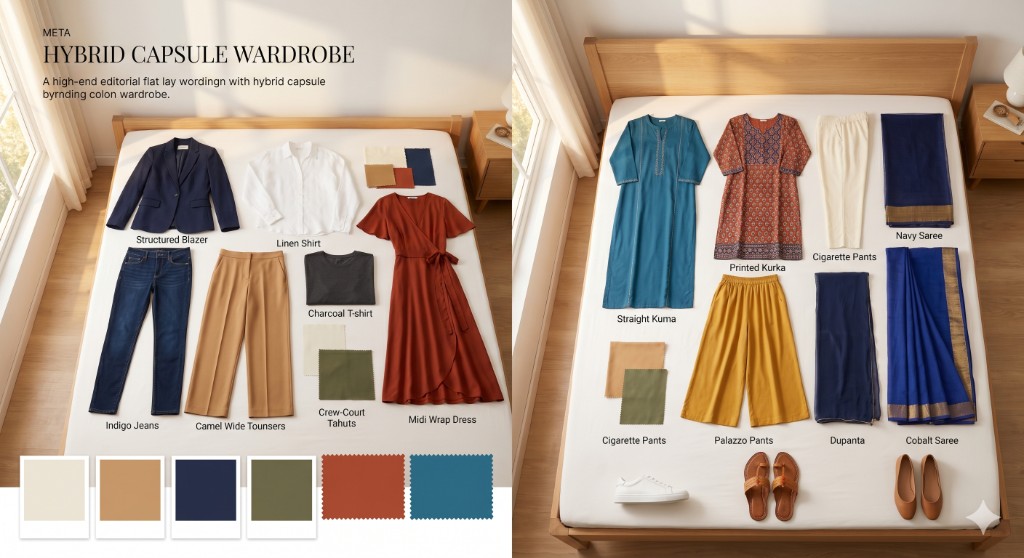
The consumers in India use two full wardrobe styles, the traditional clothes, as well as the western clothes. The sizing standards, occasions, and dressing styles for each wardrobe are distinct and unique.
An M-sized salwar suit in one system will be entirely different from an M in another system. A recommendation for buying a saree without consideration for its draping style and occasion will be meaningless. An idea for a lehenga without taking into account the buyer's physical appearance will just amount to guessing.
Ecommerce platforms handle this with filters, ethnic wear, western wear, occasion, and price range. But filters are not intelligence. They narrow the catalogue. They do not personalise it.
AI commerce can hold all of this complexity simultaneously. It knows that you need a lehenga for a winter wedding in Jaipur, that you have a pear-shaped body, that deep jewel tones work best for your skin tone, and that your budget is ₹8,000–15,000. It builds the recommendation from all of that at once, not sequentially, not approximately.
Indian skin tones span an enormous range, from very fair to very deep, across warm, cool, and neutral undertones. How a colour looks on a model in a product photo and how it looks on you can be completely different.
Global ecommerce platforms were not built with this in mind. Their recommendation engines were trained on Western fashion data, Western body types, and Western consumer behaviour. They do not know that dusty rose reads differently on a warm medium Indian skin tone than it does on the fair skin of the model wearing it.
India-specific AI commerce tools are trained on Indian fashion data. They account for the full range of Indian skin tones and recommend colours and silhouettes that actually work, not colours that work in a stock photograph.
The Indian way of life has greater diversity in terms of clothing than that of any other society. This includes office wear, casual wear, festival wear, puja wear, engagement wear, wedding wear, reception wear, mehendi wear, sangeet wear, family party wear, date wear, and travel wear.
An ecommerce filter for "occasion wear" cannot hold this. It returns everything tagged with that label, which is hundreds of products, and leaves the decision entirely to you.
An AI commerce system can understand that "I need something for my colleague's wedding reception in Chennai in February" is a specific brief, and build a recommendation that accounts for the climate, the occasion formality, the regional context, and your personal style profile simultaneously.

The AI commerce vs ecommerce distinction matters as much for brands as it does for consumers.
Indian D2C fashion brands have grown enormously over the last five years. But they face a persistent structural problem: high return rates, low conversion on product discovery, and a customer experience that feels impersonal despite significant investment in content and cataloguing.
AI commerce addresses all three at the structural level.
Lower returns: When recommendations are built around the buyer's body type, skin tone, and occasion, rather than keyword matches, the gap between expectation and reality shrinks. Customers buy things that actually work for them.
Higher conversion: A customer who is shown exactly the right product at the right moment converts at a significantly higher rate than one who has to scroll through 200 results to find something suitable.
Better product discovery: Most D2C fashion brands have deep catalogues that are poorly surfaced. AI commerce surfaces the right product to the right customer, which means more of the catalogue actually sells, not just the top-ranked items.
For Indian D2C brands, embedding AI commerce capability into their shopping experience is not a future consideration. It is a present competitive advantage.
AI commerce is not a prediction. It is already here, and Indian consumers are already experiencing early versions of it through virtual try-on tools, AI outfit generators, and personalised styling platforms built specifically for Indian fashion.
The shift from ecommerce to AI commerce in fashion follows a clear logic: the more personal the product category, the more valuable personalised intelligence becomes. Fashion is about as personal as a product category gets.
The platforms that understand this and build their product discovery around the individual rather than the catalogue will be the ones that earn long-term loyalty from Indian fashion consumers.
Ecommerce made fashion possible in India on a large scale. It was indeed something of value, and it has altered the market forever. However, access has never been the entire issue. The issue has always been personalisation, choosing something that is suitable to your individual physique, skin color, and occasion, among many choices — exactly the gap our piece on why online clothes shopping in India keeps disappointing you digs into.
AI commerce is the infrastructure that makes that personalisation possible. And on the consumer side, it sits right next to the question of whether you need an AI stylist or a human personal stylist.
Aeza is India's AI Commerce platform for fashion, built specifically to bring this shift to Indian ethnic and western wear. Personalised outfit recommendations, virtual try-on, and AI styling trained on Indian fashion from the ground up. Free for consumers, and available as an embeddable platform for D2C fashion brands.
.webp)