Updated 05 / 03 / 2026
Too many clothes, still no outfits? Understand wardrobe gaps, decision fatigue, and how AI styling simplifies dressing for Indian women.

Aeza Editorial
Core team
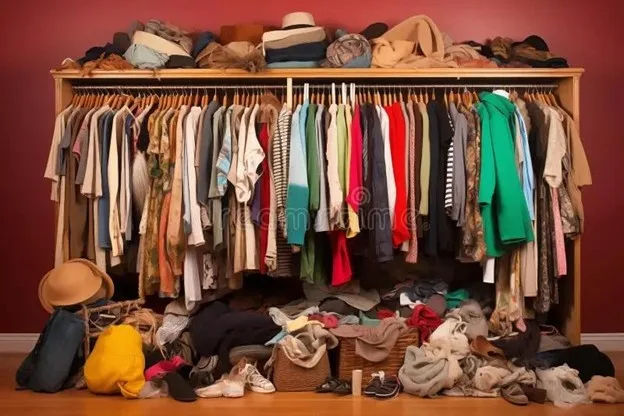
You open your wardrobe. It's full. You stare at it for five minutes. You still have nothing to wear. This happens to almost every Indian woman, and it has nothing to do with how many clothes you own.
Decision fatigue in fashion India is more common than anyone talks about. You've bought the kurtas, the western separates, the fusion sets. You have options for every occasion on paper. But every morning, the same paralysis sets in, too many choices, no clear answer, a growing pile of "maybe laters" on the bed, and eventually the same safe outfit you've worn three times this week.
The wardrobe is full. The decision is empty. That's the real problem, and it's worth understanding why it happens before trying to fix it.
Most wardrobes aren't built, they're accumulated.
A sale kurta here. A birthday gift dupatta there. A Western top was bought because it looked good on someone else. Over time, you end up with a collection of individual pieces that don't speak to each other. There's no logic connecting them.
So when you open the wardrobe, you're trying to solve a puzzle with mismatched pieces every single morning.
Here's a specific version of this problem: you have plenty of clothes, but they're clustered around the wrong occasions.
The gap isn't quantity. It's occasion coverage. Your wardrobe is full of five occasions and empty for the ten you actually live in.
Almost every wardrobe has a zone that nobody talks about, the clothes that almost fit. The kurta that's slightly off at the shoulder. The jeans that work on good days. The blouse needs a specific bra.
These clothes exist in your wardrobe. They create visual noise. And every morning, they contribute to the feeling that you have options, when in reality, you're mentally ruling them out one by one.
Decision fatigue in fashion India doesn't get enough attention as a real cognitive issue.
The brain has a finite amount of decision-making energy per day. The more choices you face, even small, low-stakes ones, the more that energy depletes. By the time you're standing in front of your wardrobe at 8 AM, your brain is already loading up tasks from the day ahead. Adding 40 silent outfit decisions on top of that is genuinely exhausting.
This is why you're more likely to make a bad shopping decision at 10 PM on a scrolling binge than at 10 AM in a calm state of mind. Same brain, different decision bandwidth.
This feels counterintuitive, but research on decision-making backs it up. More options don't make choosing easier. They make it harder.
When you had 10 items in your wardrobe at age 18, getting dressed was simple. Now, with 60 items, every morning is a small cognitive battle.
The problem isn't the number of clothes. It's the absence of a system that filters them for you, based on your body, your occasion, your mood, and what you actually want to look like that day.
"I don't know what to wear" sounds like a minor daily irritation. But it's usually a symptom of a few deeper issues:
For Indian women, this problem has an extra layer that global fashion advice almost never addresses.
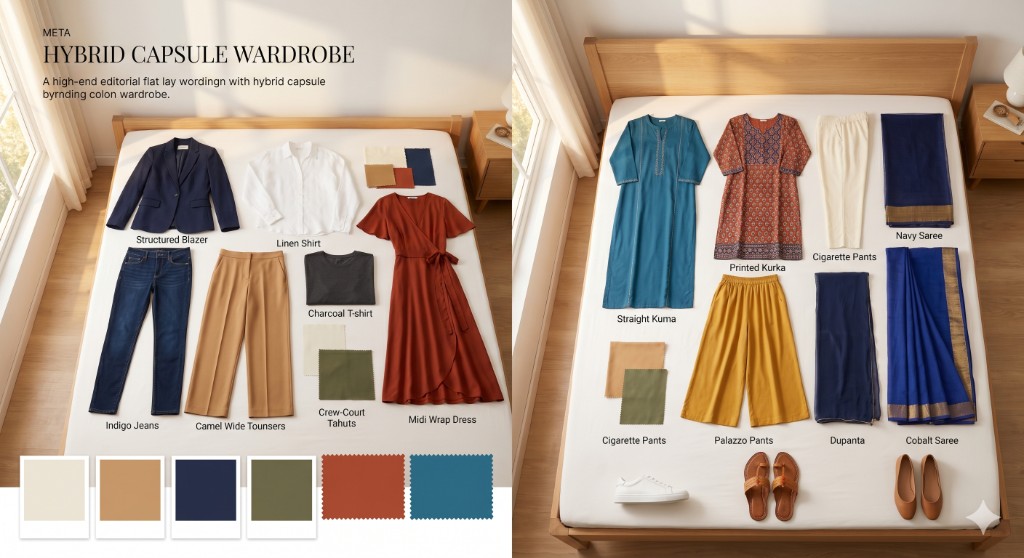
Indian wardrobes aren't western-only or ethnic-only, they're both. You need to dress for Diwali pooja, a Monday morning meeting, a college friend's intimate wedding and Sunday brunch. The range of occasions and dress codes is genuinely wider.
Add to that the incredible range of Indian skin tones and body types, and the fact that a colour recommendation made for a light-toned model may look completely different on a deeper Indian skin tone, and you start to see why generic fashion advice consistently disappoints.
Skin tone outfit suggestions built specifically for Indian women look different from what any global fashion platform offers. The colour theory is different. The fabric behaviour in Indian humidity is different. The silhouette choices for Indian body proportions are different.
This is exactly the gap that makes personalised styling for Indian women a distinct and unsolved problem.
Instead of organising your wardrobe by type (tops, bottoms, ethnic), organise it by occasion: office, casual, ethnic, formal, festive, casual ethnic, western casual.
This immediately shows you where the gaps are, and which sections are overcrowded.
Every wardrobe has a core 10–15 items that do most of the work. Identify yours. These are your styling anchors. Everything else should either pair with these items or leave the wardrobe.
Before buying anything new, ask: What does this go with in my current wardrobe? If you can name two existing pieces it pairs with, it earns a place. If not, it'll become more wardrobe noise.
This is where technology closes the gap that willpower and organisation alone can't.
An AI fashion stylist india tool does the daily matching work for you, based on your body type, your skin tone, your occasion, and what's already in your wardrobe or available to buy. Instead of standing in front of your wardrobe solving a puzzle, you get a recommendation in seconds — the same logic powering the broader shift from ecommerce to AI commerce in fashion.
This isn't futuristic. It's available now, and it's free.
A good AI styling tool for Indian women is not only a recommendation engine. It accounts for:
This level of India-specific personalisation is what separates an AI fashion stylist built for India from any global alternative.
The wardrobe-full-nothing-to-wear problem isn't about how much you own. It's about the absence of a personalised system that connects your clothes to your life, your body, your occasions, your Indian fashion reality.
The fix isn't buying more or owning less. It's getting smarter about how you put it together — the same idea behind our guide to getting dressed in 5 minutes flat.
Aeza is India's AI commerce platform for fashion, built specifically to solve this problem for Indian women. From personalised outfit suggestions based on your body type and skin tone to virtual try-on before you buy, it removes the daily decision work and gives you styling that actually makes sense for Indian ethnic and western wear.
.webp)