Updated 05 / 03 / 2026
.webp)
Stop wasting mornings staring at your wardrobe. Learn how to build a system that makes getting dressed fast & stress-free, with outfit formulas built for Indians.

Aeza Editorial
Core team
Getting dressed should not be the hardest part of your morning. But for most people, it is.
Here is the thing: a 5-minute morning is not about owning fewer clothes or waking up earlier. It's about removing the decisions before the day even starts — exactly why a full wardrobe can still leave you with nothing to wear.
When your wardrobe has a system, getting dressed stops being a daily puzzle and starts being a reflex. This blog helps you understand how to build that system, in a way that works for Indian wardrobes, Indian occasions, and the real mix of ethnic and western wear most of us actually live in. Just a practical, repeatable approach that gets you out the door faster.
It's that your wardrobe is asking you to make too many choices at once.
Every morning, your day must start with answering certain questions, like:
And so many more questions. That is outfit decision fatigue, and it compounds fast.
By the time you have ruled out three options, tried on two, and rejected one because the dupatta is missing, fifteen minutes are gone. Not because you are bad at getting dressed. Because your wardrobe has no pre-made answers.
The fastest morning routines do not work because the person is efficient. They work because the person has already made the decisions, the night before, the weekend before, or the month before, when they organised their wardrobe.
Think of it like meal prep. You do not cook faster in the morning by being a better cook. You cook faster because the ingredients are already chopped, sorted, and ready to go.
A well-organised wardrobe works exactly the same way.
Most wardrobes are sorted by clothing type: tops together, bottoms together, ethnic separate, and western separate. It makes the wardrobe look neat. It makes getting dressed harder.
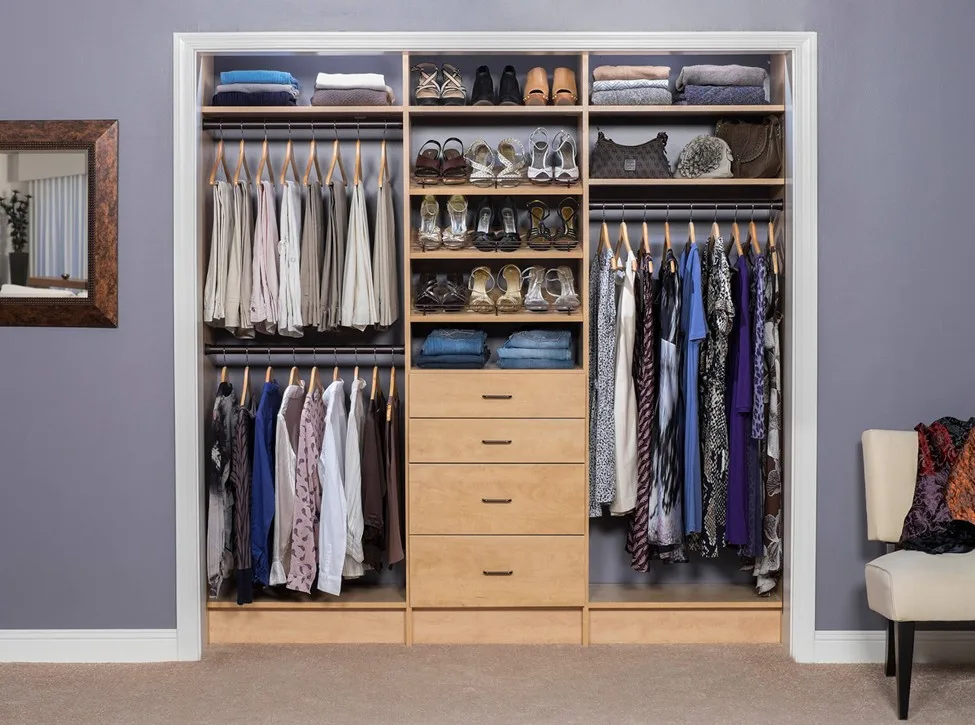
When you organise by occasion instead, you create pre-sorted outfit zones.
Try this layout:
Now, when you are getting dressed for work, you are only looking at one section, not scanning the entire wardrobe. The decision space shrinks immediately.
Go through each section and pull out anything that:
These are not bad clothes; they are simply not counted as active wardrobe items. Keeping them in the main rotation adds visual noise, slowing down every morning decision.
In simple words, an outfit formula is more like a repeatable combination that always works out for you.
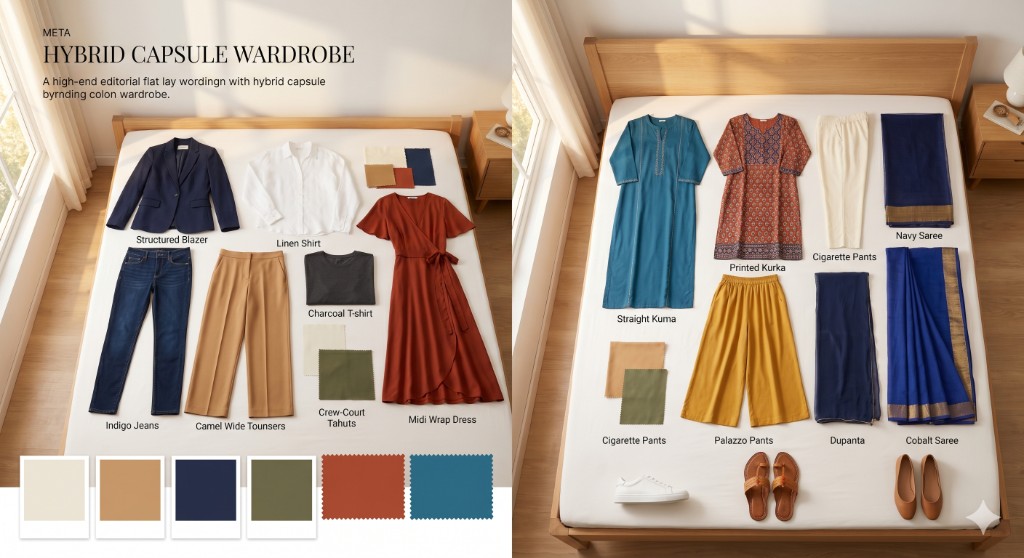
Here are a few that work for Indian wardrobes:
All you require is 5 to 6 formulas that work well and cover your actual life. Once you know your formulas, deciding what to wear becomes a matter of picking the occasion and running the right combination.
Every great outfit has one anchor piece, the item that everything else builds around.
Instead of looking at your full wardrobe, start with one anchor and build outward:
Four decisions. Maximum two minutes. Done.
Outfit decision fatigue is worst in the morning because your brain is already loading up the day ahead, meetings, commute, tasks, and conversations.
The solution is straightforward: decide on your outfit the evening prior to avoid having your mind preoccupied with other thoughts.
This will take you 90 seconds at night, but save 10-15 minutes each morning. Moreover, the decision will be made in an improved frame of mind, free from stress and more objective.
Keep it simple:
That is it. You wake up and just put it on.
And sometimes you forget. Or you get surprised by a last-minute meeting, or the weather changes, or even worse, your carefully picked outfit gets spoiled at 7 in the morning.
Always have your backup plan ready. One particular set that you can assemble in less than 3 minutes, and not give much thought to. Your wardrobe's safety net.
Simple, occasion-safe, always presentable. Know yours and keep it accessible.
Most people think they need more clothes to have more options. Usually, the opposite is true.
What creates more usable outfit options is coverage of the right connectors:
When your wardrobe has strong connectors, the number of workable combinations multiplies without adding more clothes.
A few specific gaps that create morning slowdowns for Indian wardrobes:
Each of these is a small friction point. Together, they create the daily experience of a full wardrobe with nothing to wear.
Even with a well-organised wardrobe and a set of formulas, there are mornings when nothing clicks. The occasion is unusual. You are bored with your usual combinations. You have just bought something new and do not know what it goes with.
This is where an AI fashion stylist india tool earns its place in your routine.
The goal is not to replace your personal style. It is to remove the daily decision work in the mornings when your brain has better things to do.
Getting dressed in 5 minutes is a system. Organise by occasion. Build outfit formulas. Decide the night before. Fix the gaps, not the volume — see why a full wardrobe still leaves you with nothing to wear. And when the daily decision work still feels heavy, let AI carry it.
Aeza is India's AI commerce platform for fashion, built specifically for Indian women navigating the full range of ethnic, western, and fusion dressing. From body-type-aware personalised outfit suggestions to virtual try-on before you buy, Aeza removes the friction that turns getting dressed into a morning tax.