Updated 05 / 20 / 2026

Struggling to get dressed? Here is an honest guide on how to dress confidently when you don't like your body, fit, colour, or structure that actually helps.

Aeza Editorial
Core team
This is not a guide about loving your body. It is a guide about getting dressed when you do not, and doing it well anyway. Those are two different things. And only one of them helps you on a Tuesday morning.
Most stylistic advice takes the easy route out, assuming that one is already confident and only needs guidance. However, for quite a few women, getting dressed each day comes out of insecurity, from feeling uncomfortable with themselves, from having a different body, from being in a state of low self-worth, or from being at an age where looking into the mirror is more of a challenge than a pleasure. There is real science behind why some outfits make you feel powerful, and others don't — and you can use it deliberately.
This guide is for that experience. Not the aspirational version of dressing, the real one. The one where you have to leave the house looking put-together while feeling the opposite inside.
How to dress confidently when you don't like your body is not about pretending the discomfort is not there. It is about understanding that the clothes you wear can either amplify that discomfort or reduce it, and making deliberate choices that do the latter.
That is a skill. And like any skill, it can be learned.
When you feel bad about how you look, getting dressed becomes an obstacle course — a sharper version of the everyday wardrobe-full-but-nothing-to-wear problem.
You pull things out of the wardrobe, try them on, and put them back. Nothing feels right. Everything either draws attention to the thing you are self-conscious about or feels like it is trying too hard to hide it. You end up wearing the same three safe outfits on rotation, not because you love them, but because they feel like the least wrong option. If you want a starting set that just works, our 10 outfits that build confidence at any size or shape is a useful anchor.
This cycle is exhausting. And it compounds. The worse you feel, the less effort you put into dressing. The less effort you put in, the worse you feel when you see your reflection. The worse you feel, the more you avoid the mirror, the wardrobe, and eventually the clothes shopping that might actually help.
Recognizing how this cycle works is the first step to breaking it. This is not about being motivated, about having a positive body image, or about waiting for yourself to feel better. It is about creating structure. Concrete decisions about what you wear can help you leave the house feeling good enough.
Okay is enough. Okay gets you through the day.
The single most important dressing principle when you are in a difficult relationship with your body is this: fit matters more than size.
A size 14 kurta that fits your body correctly will always look better, and feel better, than a size 10 worn uncomfortably. Clothes that pull, gap, dig in, or require constant adjustment are a continuous reminder that something is wrong. Clothes that fit sit quietly on your body and let you forget about them.
Forgetting about your clothes is the goal when you are struggling. The best outfit for a hard day is one that stops demanding your attention the moment you put it on.
Practical steps:
This is not giving up. This is building a functional wardrobe for the person you currently are, which is the only wardrobe that actually works.
When you do not feel good in your body, the instinct is often to hide in loose, oversized clothes. This is understandable. But it frequently makes things worse, not better.
Clothes that are too loose have no shape. And when clothes have no shape, the eye fills in the blank with whatever it imagines underneath, which, when you are feeling self-conscious, is never flattering.
Structure does the opposite. A structured garment has its own silhouette. It creates a defined shape on the outside that does not depend on the body beneath it to look good.
What structured dressing looks like in practice:
None of these requires you to show more of your body. They require you to give your outfit a shape, which takes the visual burden off your body entirely.
Colour is one of the most powerful and most overlooked tools in dressing for difficult days.
The wrong colour can make you look tired, washed out, or unwell, which amplifies every insecurity. The right colour does the opposite. It makes your face look more alive, your skin more luminous, and the overall impression more put-together than the effort you actually made.
Finding your two or three best colours:
Most people have a small set of colours that consistently work well against their skin tone. These are the colours people compliment you on. The ones where someone says, "You look well today," without knowing why.
For Indian skin tones, these colours tend to cluster around:
Very pale pastels and washed-out neutrals often reduce contrast against Indian skin, which can make you look flat or tired, the opposite of what you need on a hard day.
The low-confidence day rule: On a day when you feel bad about how you look, wear one of your known best colours. Not a new colour you are experimenting with. Not a trend you are unsure about. A colour you already know works. Reliability builds confidence when nothing else does.

They are not aspirational outfits. They are practical and dependable, and work every time, no matter your body type, shape, or how you feel wearing them.
A straight-cut kurta in a solid deep tone with well-fitted straight trousers is the single most reliable outfit in the Indian wardrobe for days when you need to feel put-together without effort.
The straight kurta creates a vertical line. The straight trousers extend it. The result is a clean, elongated silhouette that works for every body type and requires no styling decisions beyond the colour choice.
Wear it with simple earrings and clean footwear. That is the whole outfit. It is complete.
The wrap dress silhouette succeeds since it conforms to your form rather than dictating a certain one. The V-neck pulls focus to your face. The waistline adds proportion to the look. The skirt flows away from the body in a neat manner.
In the Indian perspective, wearing a wrap kurta over palazzos will provide the same effect in ethnic attire, comfortable and effortless, with absolutely no effort required post-wear.
A blazer is the most reliable confidence garment in any wardrobe. It adds structure to the upper body, draws the eye to the face and shoulders, and immediately makes any outfit look intentional.
On a day when nothing feels right, put a blazer over the plainest thing in your wardrobe. The blazer does the work. You do not have to.
Wearing one colour from head to toe creates an unbroken vertical line that visually lengthens and simplifies the silhouette. It requires minimal decision-making, which is important when your mental energy is already stretched, and consistently reads as put-together.
In Indian ethnic wear, a tonal kurta-trouser set or a single-colour saree with a matching blouse achieves the same effect. One colour, clean lines, done.
Some dressing habits feel protective, but actually make things worse. These are worth identifying and interrupting.
Do not wait to look great until you feel better. The reason why dressing up can make you feel better is that you are missing out on that confidence that you will feel when you dress nicely. The act of doing so helps to create the feeling.
Do not buy things in sizes that you hope you will become. This will just serve as an unneeded reminder that there are areas that you still need to improve on. Dress the body that you currently have.
Stop wearing clothes that require management. Anything that needs to be constantly adjusted, pulled down, held in, or thought about is not serving you. A garment that demands your attention all day keeps you focused on your body, which is the opposite of what you need.
Stop equating loose with comfortable. Loose and comfortable are not the same thing. A well-fitted kurta that skims your body is more physically and emotionally comfortable than an oversized one you are hiding in. Fit is comfort. Drape is comfort. Shapelessness is not.
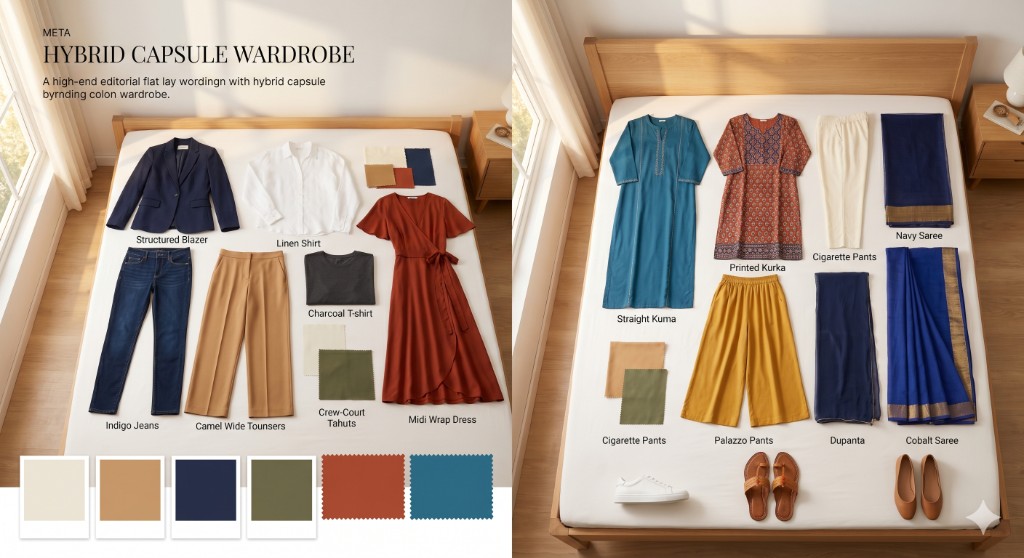
This is not about getting a completely new wardrobe. This is about having five to seven outfits that consistently make you feel okay, and then wearing them with no guilt.
Minimum working wardrobe:
That is it. Six pieces, all of which fit, all of which work. Rotate them without apology. Build from there when you are ready.
The practice of dressing up when you're unhappy with yourself does not imply lying to yourself. Instead, it involves minimizing the additional friction in the already complicated process by understanding that appropriate clothing, suitable colors, and some proper structure will accomplish this effortlessly — there is real science behind why some outfits make you feel powerful and others don't, and you can use it.
Your clothes can hold you up on the days you cannot hold yourself up. Let them. If you're rebuilding after a body change, our guide on rebuilding your wardrobe after weight loss in India walks through it step by step.
If you want personalised outfit recommendations matched to your current body type, skin tone, and the occasions your life actually requires, Aeza, India's AI Commerce platform for fashion, builds those recommendations specifically for Indian women. Free, available whenever you need it, and trained on the full range of Indian ethnic and western wear.